
The scoreboard in the gymnasium hadn’t moved. Red digits, forty-six minutes past when the competition was supposed to start.
I was in the stands with the other parents. Phones were out and low conversations occurred, the patience that sets in when nobody knows how long the wait will be. My wife leaned over: “At what point do they actually do things?”
Around us, the answer was forming without anyone deciding it. Well, this is just what you expect. You kind of have to expect these things.
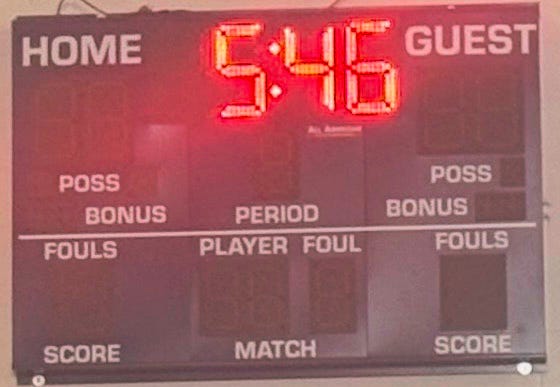
The kids on the floor below were ready. They’d been ready at the hour.
Nobody declared the delay acceptable. It became that, one shrug at a time. Somewhere in that accumulation, the community stopped holding a standard on the organizers’ behalf. It stopped believing the organizers were capable of meeting one.
That’s what resignation looks like when it’s dressed as patience.
I had a senior English teacher in high school, Angela Nagengast, who would not lower the bar. Bad writing came back with bad grades. There was no softening for effort alone, no partial credit for good intentions. The work was returned, and the expectation was that I could do it better.
At the time, it felt like severity. It was the opposite.
She was making a declaration about what she believed I was capable of. Lowering the bar would have been the unkind thing. It would have been a verdict on my ceiling, made before I’d had the chance to find it myself. What she gave me wasn’t lenience. She believed that I could clear the real bar and provided enough friction to prove it.
Ten years ago, I was refereeing rugby under Matt Eason. He pushed back against thinking in two categories.
“Don’t say acceptable or unacceptable,” he told me. “Think perfect, acceptable, unacceptable. And if you have two acceptables in a row, your job is to get back to perfect. Get in position. Vocalize. Make the call. Because if you keep saying it’s acceptable rather than perfect, the standard will slip.”
What’s tolerated at minute five is expected by minute thirty. By minute seventy, it’s the baseline. No decision was made. Acceptable did the work that perfect used to do, slowly, until the difference stopped being visible.
Lowering the bar isn’t kindness. It’s a vote of no confidence.
For people in public service and higher education, the gymnasium is everywhere. It’s the office that got dingy so gradually nobody thought to mention it. The call that went unreturned for a day, then two, then indefinitely, because this is just how things are now. The student’s work that stopped coming back with a standard and started coming back with encouragement, until the encouragement was all there was.
Each of these has its own version of the parents in the stands. People who have decided that accommodation is the mature response and have called it grace.
Grace is different. Grace holds the bar and helps people back to it. It doesn’t lower the bar and call that meeting people where they are. It holds the bar at height, and does the harder work of believing someone can clear it.
Mrs. Nagengast believed something about me I hadn’t yet earned. That belief was the gift.
The question for anyone holding a standard isn’t what you’ve publicly committed to. It’s what you actually hold. Whether the office looks like somewhere people want to be. Whether the call gets returned. Whether the work that comes back from you carries an expectation or just encouragement.
The return to a higher standard doesn’t require an announcement. It requires position, presence, and the willingness to make the next one count.
There are evenings I sit scrolling when the work is waiting. I’ve called it acceptable often enough that it stops feeling like a choice. I know what it costs, even in the moments I’m paying it.
The competition eventually started. The kids were excellent, the way kids are when they’ve prepared and finally get their moment.
If something here landed differently than you expected — I’m reachable by reply.