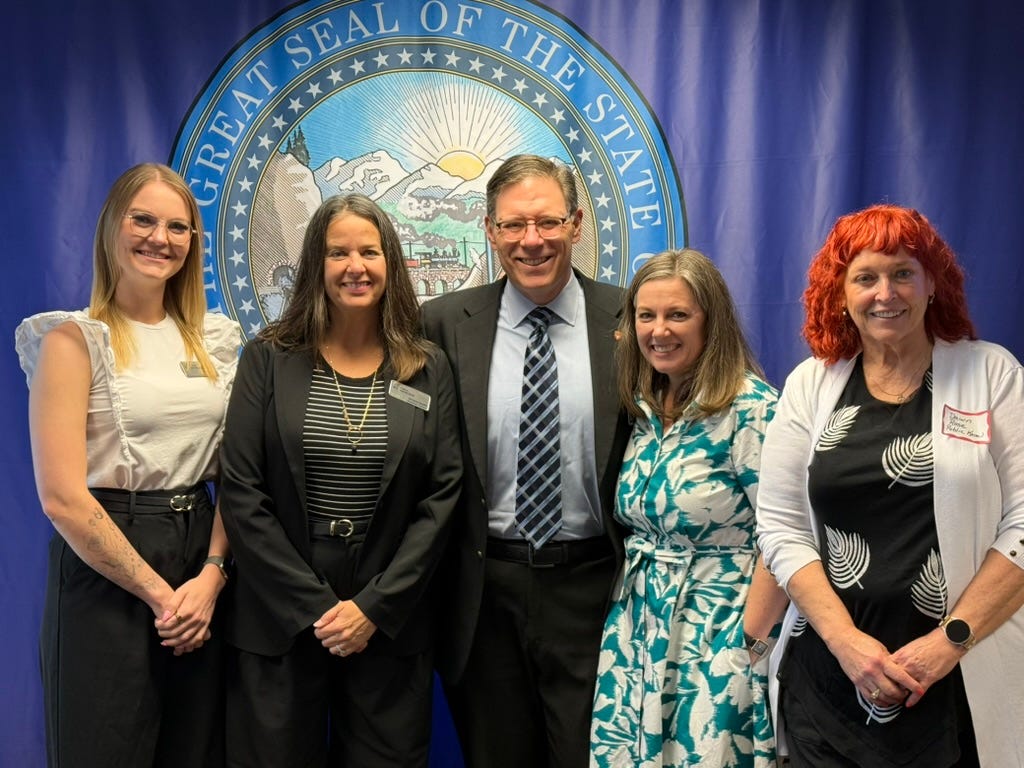
The bar had casino machines along the back wall. Our waitress had opinions about the menu. We asked what to order. She was right about the clam chowder.
Nobody was in a hurry to leave.
Two days of Project Kickoff were behind us with the Department of Human Services. Debrief done, slides submitted, the particular quiet that arrives after something hard ends well. Dawn Rose was sitting at the table. We’d worked with her before, back when Civic Initiatives was a partner organization. Now she was one of us, and this had been her first time seeing PK from the inside.
Over the course of the evening, in the way conversations drift after difficult work is finished, Dawn started talking about what she’d seen. What she’d noticed about how we operated. Decentralized. Independent-minded. Each person owning their lane without waiting to be told. A matrix that functions because everyone in it takes real ownership, and that requires a lot of work and a particular kind of trust. She’d been watching for three days, and she’d understood it. She was describing it back to us.
Brie Thompson listened. Then she looked at Dawn and said: “We’re so glad you’re here as part of us.”
Dawn had already earned her way in before anyone said so.

Matrix organizations have been in vogue for a while. The idea of a decentralized team, each person operating independently, managing across rather than up and down, appeals to something real. It’s how genuinely complex work gets done. What the conversation about matrix organizations has always tended to skip is the part underneath: what holds the structure up.
Three days earlier, we’d come into this engagement with a good team. Christina Remlin, who had just earned her PMP. Brenna Kessler. Bree Thompson. Jen Jennings. Dawn Rose, on her first full PK engagement. I knew the people. I believed in them. Believing in a team is different from knowing what they’ll do when slide changes come in five minutes before the session starts, the room’s energy shifts, and you’re making judgment calls minute to minute.
I like to plan. I like to know what’s coming and build in a buffer for what doesn’t. This engagement stripped most of that out early, and what it left in its place was a decision I had to keep making: step back. Let them work. The pull to get in there, to contribute, to be useful, to do something, didn’t disappear because I made the decision once. It was still there on day two, watching Christina do exactly what needed to be done, wanting to add something. I made myself not.
That’s the part that doesn’t make it into the conversations about matrix leadership. The decision isn’t structural. It’s personal, and it runs against the grain for anyone who came up through this work because they loved it.
Christina stepped into a level of leadership and partnership I couldn’t have predicted. Her being in that room was the difference between adequate and another level. Dawn owned the IT section entirely. She understood it, jumped into it, and never let that ownership close her view of the whole. Brenna marshaled the room in a way that’s its own kind of gift. These weren’t things I managed. They happened because the trust underneath the structure held.
And Brie, who is my boss, was making the same call I was making. Stepping back. Not filling space that was already being filled. Trusting the people around her to do what they’d come to do, without knowing in advance what they’d find in themselves. Every layer makes the same conscious move at the same time, on the same faith.
That’s the matrix actually working.
And so when Dawn was the one at dinner describing it back to the table, telling us what she’d seen, that was the proof of it. She’d absorbed it in three days. She’d understood it well enough to name it. And Brie listened to all of it and said, simply: we’re so glad you’re here as part of us.
You don’t know what you’ve built until a newcomer absorbs it, explains it back to you, and gets it exactly right.
I should have said that in the room, while we were all still there.
If something here landed differently than you expected — I’m reachable by reply.