
Sitting in a high-level meeting this week, I watched the most important thing in the room happen, quietly with minimal fuss, and it was a privilege just to see it unfold.
This was a big meeting; there’s no two ways about it. The stakes were high, the profile was high, and people came with intensity, each carrying their own piece of whatever needed to get done. As the primary facilitator, I spent much of my time watching faces rather than slides. I needed to see who leaned in, who went quiet, and how the room reacted to each person as they spoke. It was an almost sterile room, with white walls and big tables, TV screens on the wall ready for a video conference, and over 30 very important people all looking at each other.
A colleague of mine at the table had a big role to play later on. She carried the nerves we all carry before we are put on the spot for the big moment, the ones that have nothing to do with competence and everything to do with caring how it goes. She didn’t show them obviously, but when you have them as well, you know they are there. Over the course of the morning, she had worked her way through two small bottles of water. I noticed it the way you notice most things in a long meeting, without really registering it. I nursed a much larger bottle of water for the same reason.
Out of the corner of my eye, I saw Naomi Snodgrass from Public Knowledge, who had been sitting beside me, look at something. She quietly got up and walked behind me over to the other side of the room. I hadn’t been paying attention at all. People get up in meetings. It’s the least remarkable thing in the world.
Yet, Naomi is one of the most senior people at PK, and when she moves and acts, she does so with deliberateness. It is never for urgency or show. It comes with a certain amount of care and kindness. She is the person who will sit with you as you talk about your kid’s activities and live in the moment with you. She will ask you how you are doing after a long trip. And, she always hugs you to let you know she cares.
Coming back to her seat, I saw she carried two small bottles of water. She nudged them over to Bree Thompson, who was sitting beside her, and said something to Bree very, very quietly. Bree then, just as quietly, set the two new bottles next to the old ones, so that our colleague had a fresh supply waiting for her.
That was it. The whole thing took perhaps thirty seconds. Almost no one else in the room saw it, and I only did because I was sitting right next to them.
At the time, it looked innocuous. To most people, it probably looked like Naomi had gone to get a couple of bottles of water for herself. But the act was for another, an act of supreme care for another human being.
My stepfather was the first person to tell me about staffing. When I was about 12, he sat me down with an old VHS copy of Patton, and partway through, he paused the tape. “I want you to see this scene,” he said, “because this is what service and staffing truly are.” This was in the TV room of a rundown old house, and I can still remember the lines of static that only occurred with a VHS pause.
Having lost his aide, Captain Jenson, Patton is coming down a staircase, describing what he needs to have happen, and he is about to interview for a replacement. Every time his cigar starts to go out, a man appears and lights it. He does not announce himself or ask for anything. He just keeps showing up. Finally, Patton stops and asks who he is, and the man introduces himself as Lieutenant Colonel Codman. Patton recognizes Codman as his new aide and proceeds to explain his vision.
It is something very simple. It is taking care of a cigar. That was the lesson my stepfather wanted me to take from it: if you really want to understand how to staff a person, not just as an administrative assistant but truly taking care of them the way a staff officer or staff official would, you have to be two steps ahead of where they think they need to be at any given point.
Codman was real, and the tradition he stepped into is an old one. He became Patton’s aide-de-camp after Jenson was killed in North Africa, and he stayed in the role for the rest of the war. The aide-de-camp is older still. The term is French for “camp assistant,” and on Napoleon’s staff, such officers served as his eyes and as interpreters of his mind to subordinate commanders. The modern staff officer came out of Napoleon’s victories, too. After Prussia’s defeat at Jena in 1806, the Prussians built a general staff that existed unofficially from 1806 and was formally established in 1814, with officers chosen for intelligence and proven merit rather than patronage or wealth, and put through exhaustive training. The US took this tradition on, and the staff officers are the heart of any senior officer’s work.
In the two centuries since, militaries have built that tradition into the way they train, promote, and think, so thoroughly that from the inside it stops looking like anything at all. I have talked with officers in both the Army and the Air Force who did not understand how special it is, because to them it is simply part of who they are. It is not a skill they picked up, but a way of being they grew into. Anticipating what the commander will need, clearing the path before anyone asks, and staying out of the frame, none of it registers as remarkable to the people who do it every day. When I told one officer that the only higher education institutions that teach this skillset are in the military, she was shocked and tried to find a counterexample. She couldn’t.
My education on staffing was fleshed out years later by Barb Smith, when I worked in the Montana Legislature. Barb showed the way, modeling day after day what a good staffer does for the people around them. I remember a Democrat and a Republican standing in her office, both asking for budget information. Before either of them could finish a sentence, Barb was already pulling a piece of paper out of a folder and handing it over to them both, because she knew what they were going to ask for. They didn’t even react. It was just the normal course of affairs for a good staffer.
For Codman, it was a cigar. For Barb, it was a piece of paper pulled from a folder. For Naomi and Bree, in a boardroom with no uniforms in it, it was two bottles of water. They saw the need before it became a need. Our colleague never had to look around, never had to catch someone’s eye, and never had to wonder whether she would run dry at the worst possible moment. When her time arrived, the water was there, and she could speak with authority.
Staffing is often mistaken for service in the small sense: fetching, carrying, and scheduling. Really, it's about the person, not the task. The task is only the visible part. Underneath it sit attention, anticipation, and discretion. Discretion may be the hardest of the three, because the whole point is that no one notices. Things are simply taken care of, so that the person at the heart of it does not have to worry.
That, to me, is the essence of care. It is the essence of staffing and of what we do for another human being.
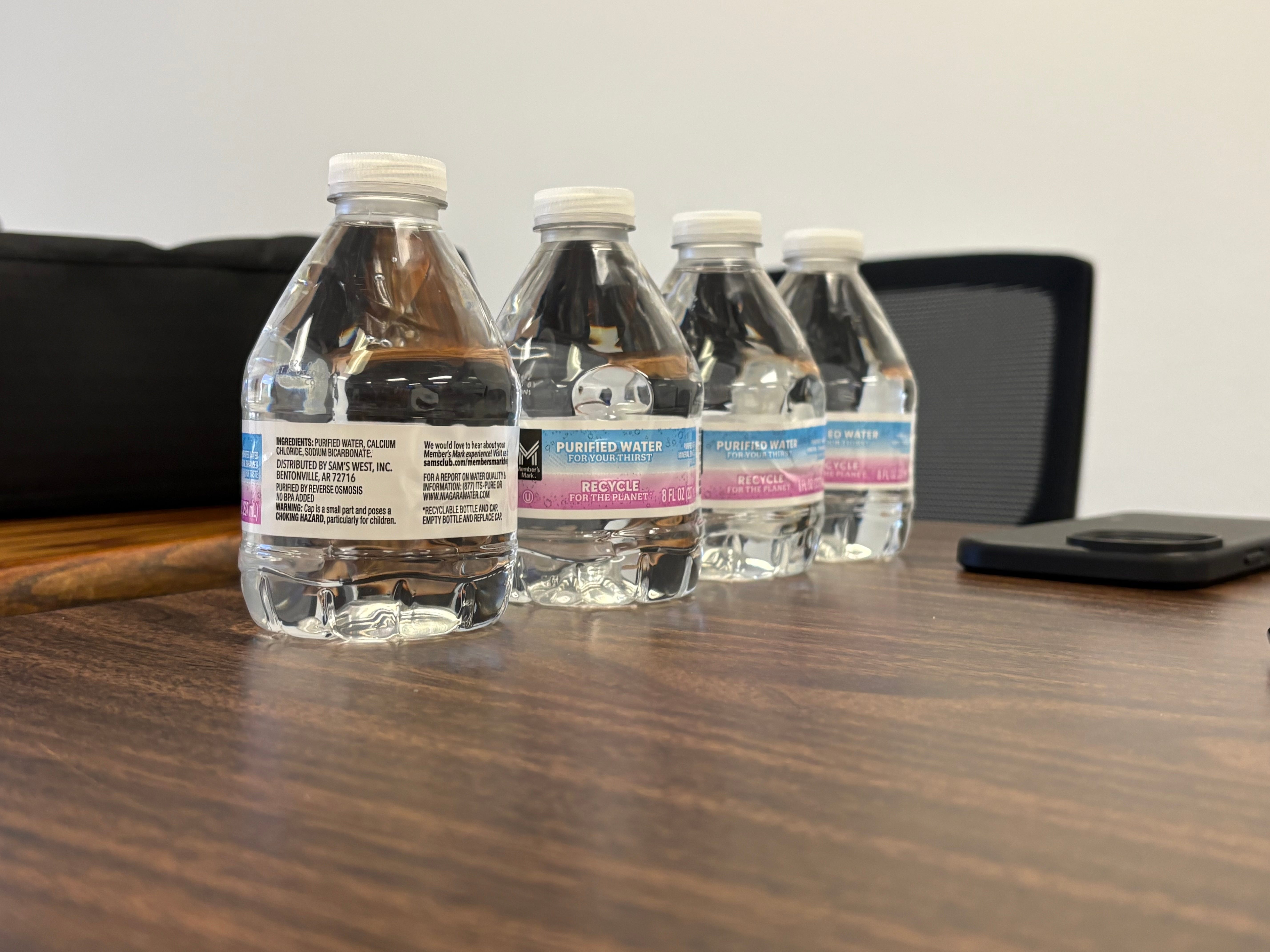
I have sat in a great many meetings, and most of what happened in them I have forgotten. I will remember this one for a long time. There were four bottles on the table, but it was the two more bottles that mattered.